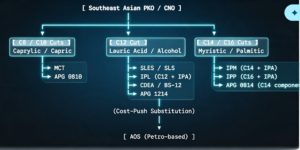
Understanding how different carbon cuts (C8 through C16) break down in the fractionation tower allows you to predict which other ingredients are about to face price adjustments, and why.
A single oleochemical refinery tower doesn’t just produce one chemical; it separates PKO into precise carbon fractions. When upstream raw material costs shift, each carbon fraction moves its corresponding downstream products:
C8 / C10 Cuts (Caprylic / Capric):
These lighter fractions are the direct precursors for MCT (Medium Chain Triglycerides) when esterified with glycerin. In the surfactant space, C8/C10 cuts feed directly into APG 0810 (Alkyl Polyglucoside).
C12 Cut (Lauric Acid / Alcohol):
Accounting for nearly 50% of the PKO fraction, C12 is the giant of personal care chemistry. A cost spike here impacts SLES / SLS, IPL (Isopropyl Laurate), CDEA (6501), BS-12, and forms the primary backbone for APG 1214.
C14 Cut (Myristic Acid / Alcohol):
C14 feeds directly into IPM (Isopropyl Myristate). It also serves as a crucial component in broad-spectrum non-ionics like APG 1214 and APG 0814.
C16 Cut (Palmitic Acid):
This heavier fraction is esterified with Isopropyl Alcohol (IPA) to yield IPP (Isopropyl Palmitate).
The ripple effect of a C12 price spike extends beyond bio-based oleochemicals into petro-based chemistry.
As SLES prices soar due to expensive C12-14 alcohol feedstocks, formulators face immediate margin pressure. To mitigate costs without sacrificing lather or performance, many primary cleaning and personal care formulators shift part of their anionic surfactant load toward AOS (Sodium Alpha-Olefin Sulfonate).
Because AOS is derived from petroleum-based $\alpha$-olefins, it serves as a direct functional substitute for SLES. However, as global demand surges toward AOS as an economic alternative, AOS market availability tightens, triggering a secondary price wave in the petro-surfactant market.
A single manufacturing plant only sees the three or four items rolling off its own line. They rarely track how fractionation economics in one carbon cut shift cost structures in another.
In a volatile market, working with a partner who understands the holistic oleochemical supply chain provides a critical strategic edge:
Cross-Product Foresight: Recognizing how a spike in C12 affects your primary surfactants (SLES/APG 1214), while simultaneously tracking C8/C10 movements for MCT/APG 0810 and C14/C16 adjustments for IPM/IPP.
Securing Legacy Allocation: Identifying suppliers with locked-in raw material positions before factory-wide price resets take effect.
Consolidated Logistics: Combining surfactant bases (SLES, AOS, APG) with specialty esters (IPM, IPP, MCT) into unified shipments to optimize freight and handling costs.
The market is moving fast. As fractionators re-quote their base fatty acid prices post-exhibition season, the window for securing pre-hike inventory across C8–C16 derivatives is closing.
Whether your formulation relies on SLES, AOS, APG series, or ester bases like IPM, IPP, and MCT, now is the time to audit your supply commitments before the next price reset lands.